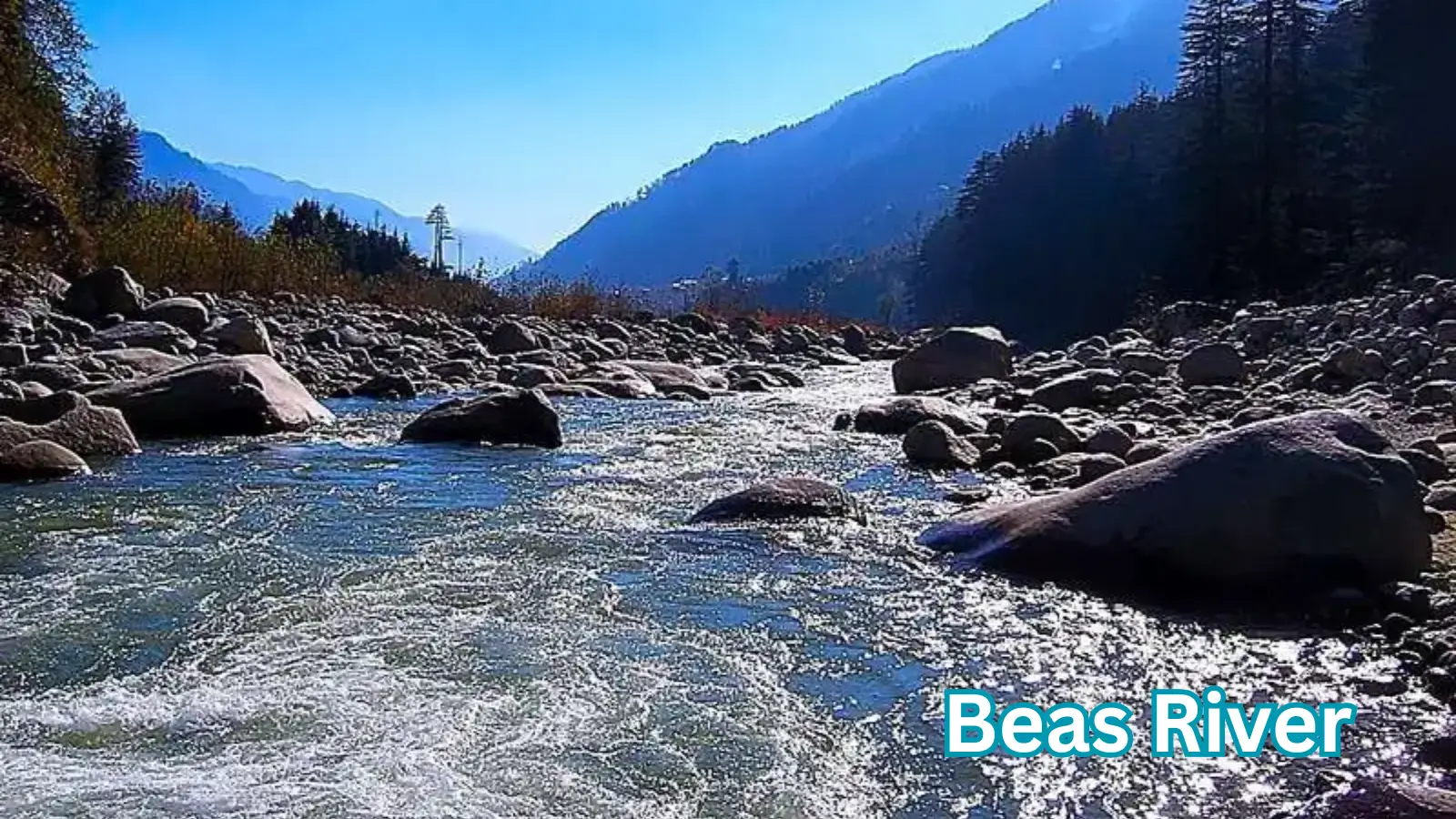
The Beas River is a major perennial river in northwest India, forming part of the Indus River System. Along with the Jhelum, Chenab, Ravi, and Sutlej, it contributes to the intricate network of rivers that drain into the Indus and ultimately the Arabian Sea.
In the Rigveda, the Beas River is referred to as Vipāśā (Vipasha). In ancient Greek accounts, it was known as Hyphasis and marked the easternmost limit of Alexander the Great’s invasion of India in 326 BCE.
Also read: Rigvedic, Ancient, and Greek Names of Rivers of the Indus Valley System
 Indian Geography: Indian Drainage System
This article is part of Indian Drainage System. To get complete information, please read associated articles.
Beas River Origin / Source
The Beas River originates at Beas Kund, a high-altitude glacial basin near the Rohtang Pass in the western Himalayas of Himachal Pradesh, at an elevation of approximately 4,361 metres (14,308 feet) above sea level.
The river is fed by snowmelt, glaciers, and monsoon rainfall, making it perennial.
Beas River Map
The Beas River map and its linkage with the Indus River system is given below.

Beas River Course
The Beas follows a distinctive mountainous and plain course before its confluence.
(i) Upper Course (Himalayan Region): The upper course of the Beas River lies in the western Himalayas of Himachal Pradesh, where the river originates from Beas Kund near Rohtang Pass at an elevation of about 4,360 metres.
In this mountainous stretch, the river flows predominantly southward through the Kullu Valley, passing towns such as Manali and Kullu, before reaching Mandi. The river here is swift-flowing, narrow, and deeply entrenched, actively engaged in vertical erosion due to steep gradients and high velocity.
Snowmelt from glaciers and seasonal monsoon rainfall provide perennial flow. Classic youthful river features such as V-shaped valleys, gorges, rapids, and waterfalls are prominent. Several important Himalayan tributaries, including the Parbati, Uhal, Sainj, and Tirthan, join the Beas in this stretch, significantly increasing its discharge.
(ii) Middle Course: In its middle course, the Beas descends from the Himalayan foothills and enters the Shivalik and sub-Himalayan regions, flowing westward and south-westward through parts of Kangra and Hoshiarpur districts. The river gradient decreases, leading to a reduction in erosive power and a relative increase in lateral erosion and transportation.
The valley becomes wider, and the river begins to meander moderately, depositing alluvium along its banks. This stretch hosts major hydraulic structures such as the Pong Dam (Maharana Pratap Sagar), which plays a vital role in irrigation, flood control, and hydroelectric power generation.
Tributaries like Banganga, Luni, and Suketi Khad join the Beas in this course, enhancing its volume and basin coverage.
(iii) Lower Course: The lower course of the Beas River lies entirely in the alluvial plains of Punjab, where the river flows slowly through districts such as Kapurthala, Jalandhar, and Tarn Taran. Here, the river exhibits typical mature to old-stage fluvial characteristics, including wide meanders, floodplains, natural levees, and occasional braided channels due to heavy sediment load. Vertical erosion is minimal, and deposition dominates, making the region agriculturally fertile.
The Beas finally joins the Sutlej River at the Harike Wetland, a major Ramsar-listed wetland of international importance. This confluence marks the completion of the Beas’ independent course, after which its waters continue through the Indus river system into Pakistan.
The lower course is ecologically significant, supporting rich biodiversity, including the endangered Indus river dolphin.
Beas River Length and Drainage Basin
The Beas River has a total length of approximately 470 kilometres, making it one of the important medium-length rivers of the Indus River System. From its source at Beas Kund near Rohtang Pass in the western Himalayas, the river traverses rugged mountainous terrain in Himachal Pradesh before descending into the Punjab plains, where its gradient reduces sharply.
Although shorter than rivers such as the Sutlej and Chenab, the Beas plays a crucial hydrological role due to its perennial nature, substantial tributary contribution, and regulated flow through major dams. Its entire course lies within Indian territory, which is a distinguishing feature among Indus system rivers
Drainage Basin of the Beas River: The drainage basin of the Beas River covers an area of approximately 20,300 square kilometres, entirely within India, and forms an integral sub-basin of the Indus River Basin. The basin extends across the mountainous regions of Himachal Pradesh and the fertile alluvial plains of Punjab, encompassing varied physiographic zones including the Greater Himalayas, Lesser Himalayas, Shivaliks, and Indo-Gangetic plains.
In the upper basin, the drainage pattern is predominantly dendritic, shaped by complex lithology and steep slopes, while in the plains it becomes more meandering and depositional.
The basin supports intensive irrigation agriculture, dense human settlements, and major water infrastructure such as the Pong Reservoir, making it economically significant as well as environmentally sensitive. Seasonal snowmelt, monsoonal rainfall, and controlled releases from reservoirs together regulate the basin’s hydrological regime.
Beas River Tributaries
The Beas River is fed by numerous snow-fed and rain-fed tributaries, most of which originate in the western Himalayan ranges of Himachal Pradesh and the Shivalik foothills. In its upper mountainous course, important tributaries such as the Parbati, Uhal, Sainj, and Tirthan join the Beas, significantly increasing its discharge and maintaining perennial flow.
The Parbati River, one of the largest tributaries, drains the high-altitude Parbati Valley and contributes substantial glacial meltwater.
In the middle course, tributaries like the Banganga, Luni, and Suketi Khad join the river as it descends into the sub-Himalayan region, carrying monsoonal runoff and sediments. These tributaries collectively shape the river’s hydrology, sediment load, and basin morphology, and they play a crucial role in sustaining irrigation, hydropower generation, and ecological balance within the Beas basin.
Beas River Mouth / Confluence
The Beas River completes its independent course by confluencing with the Sutlej River at the Harike Wetland, located near Harike town in Tarn Taran district of Punjab. This confluence occurs in the lower alluvial plains, where the river gradient is very gentle and depositional processes dominate. The meeting point is of exceptional hydrological and ecological significance, as the combined waters of the Beas and Sutlej continue westward and ultimately form part of the Indus River system flowing into Pakistan.
The Harike Wetland, created by the construction of a barrage on the Sutlej–Beas system, is a Ramsar-designated wetland of international importance, supporting rich biodiversity, migratory birds, and aquatic species, including the endangered Indus river dolphin. From an exam perspective, this confluence is crucial because it marks the point where the entire discharge of the Beas is transferred to the Sutlej, reinforcing the Beas’ role as a significant tributary rather than a direct tributary of the Indus.
Beas River Dams, Barrages, Canals
The Beas River has been extensively regulated through a network of dams, barrages, and canals developed under the Beas Project, which is a key component of India’s post-Independence river-valley development in the Indus Basin.
The most important structure is the Pong Dam (Beas Dam), located near Talwara in Kangra district of Himachal Pradesh, which has created the Maharana Pratap Sagar Reservoir. This large earth-fill dam serves multiple purposes, including irrigation, flood moderation, and hydroelectric power generation, and supplies water to vast agricultural areas of Punjab, Haryana, and Rajasthan.
Upstream of Pong, the Pandoh Dam near Mandi plays a strategic role in the Beas–Sutlej Link Project, diverting Beas waters through tunnels to the Dehar Power House on the Sutlej River, thereby supporting large-scale hydropower generation. Downstream, structures such as the Shahnehar Barrage and associated canal system distribute regulated Beas waters for irrigation and power generation in the Punjab plains. Collectively, these engineering works have transformed the Beas into one of the most intensively managed rivers of the Indus system in India
FAQs Associated with Beas River
Question: Where does the Beas River originate?
Answer: The Beas River originates from Beas Kund, a glacial lake located near Rohtang Pass in the western Himalayas of Himachal Pradesh, at an elevation of about 4,360 metres above sea level. The river is primarily fed by glacial melt and monsoon rainfall, which makes it perennial.
Question: Which river does the Beas join and where?
Answer: The Beas River joins the Sutlej River at the Harike Wetland, near Harike town in Tarn Taran district of Punjab. This confluence is hydrologically important because the combined waters later become part of the Indus River system flowing into Pakistan.
Question: Is the Beas River part of the Indus River System?
Answer: Yes, the Beas River is an integral part of the Indus River System. It is one of the eastern tributaries of the Indus, contributing its waters to the Sutlej, which later merges with the Chenab and finally the Indus River.
Question: What is the total length of the Beas River?
Answer: The total length of the Beas River is approximately 470 kilometres. Its entire course lies within India, mainly through Himachal Pradesh and Punjab, which is a distinctive feature among rivers of the Indus system.
Question: Which states does the Beas River flow through?
Answer: The Beas River flows through Himachal Pradesh in its upper and middle courses and through Punjab in its lower course. The river does not directly flow through any foreign country.
Question: What are the major tributaries of the Beas River?
Answer: Major tributaries of the Beas River include the Parbati, Uhal, Sainj, Tirthan, Banganga, Luni, and Suketi Khad. Most of these tributaries originate in the Himalayan and sub-Himalayan regions, contributing significantly to the river’s discharge.
Question: Which dams are built on the Beas River?
Answer: The most important dams on the Beas River are the Pong Dam (Beas Dam) and the Pandoh Dam. Pong Dam creates the Maharana Pratap Sagar Reservoir, while Pandoh Dam diverts Beas waters to the Sutlej River under the Beas–Sutlej Link Project for hydropower generation.
Question: What is the Beas–Sutlej Link Project?
Answer: The Beas–Sutlej Link Project is a major inter-basin water transfer scheme in which water from the Beas River is diverted at Pandoh Dam through tunnels to the Dehar Power House on the Sutlej River. The project supports large-scale hydroelectric power generation and irrigation.
Question: What is the significance of Harike Wetland?
Answer: The Harike Wetland is a Ramsar-listed wetland of international importance located at the confluence of the Beas and Sutlej rivers. It supports rich biodiversity, including migratory birds and aquatic species, and plays a crucial role in flood control and ecological regulation in Punjab.
Question: What was the ancient name of the Beas River?
Answer: In ancient Indian texts, the Beas River was known as Vipasha, while Greek historians referred to it as Hyphasis. The river marked the easternmost limit of Alexander the Great’s invasion of India in 326 BCE.
Question: What type of drainage pattern does the Beas River basin exhibit?
Answer: The Beas River basin largely exhibits a dendritic drainage pattern, particularly in the Himalayan and sub-Himalayan regions, due to relatively uniform lithology and structural conditions.
Sources and References
Factual information is compiled from standard geography textbooks and official government sources. Interpretations and explanations are original.
- Read this article to understand basic terminology associated with the drainage system and river system.
- NCERT Class XI — India: Physical Environment
- Document on Jhelum River by Water Resource Information System (WRIS) of Ministry of Jal Shakti