Understanding the stages of the UPSC Civil Services Examination is essential for aspirants because each stage has a distinct purpose, structure, and evaluation method. Preparation strategy and performance requirements differ significantly across stages.
Overview of UPSC Exam Stages
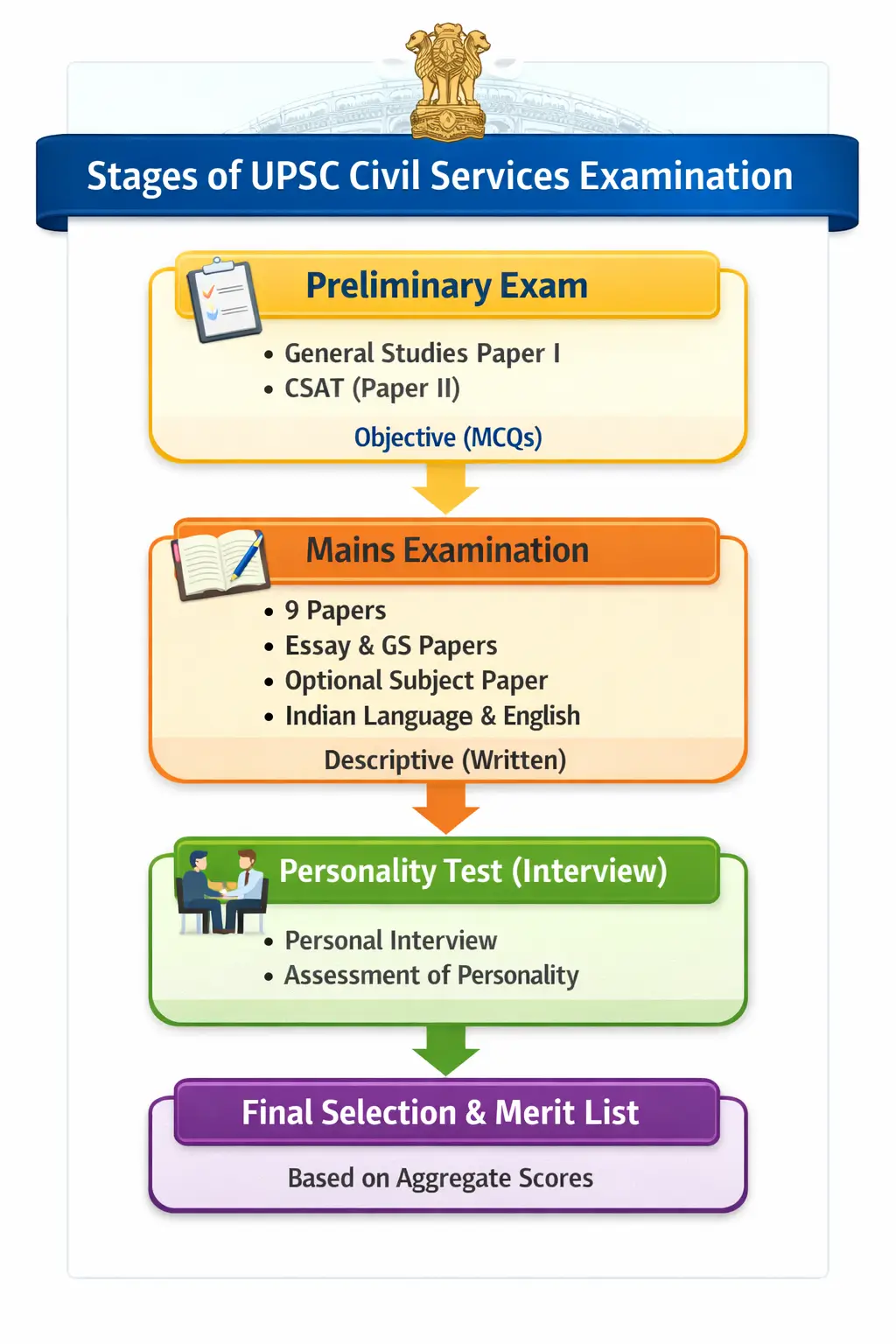
UPSC Exam stages consists of three successive stages. A candidate must qualify at each stage to proceed to the next.
| Stage | Purpose | Nature | Counts for Final Merit |
|---|---|---|---|
| Preliminary Examination | Screening and shortlisting of candidates | Objective (MCQ) | No |
| Main Examination | Assessment of academic depth and analytical ability | Descriptive (Written) | Yes |
| Personality Test (Interview) | Evaluation of personality and suitability for civil services | Board Interview | Yes |
Stage I: UPSC Civil Services Preliminary Examination
The Preliminary Examination acts as a screening test to shortlist candidates for the Main Examination. Marks obtained in this stage are not included in the final merit ranking.
Structure of the Preliminary Examination
| Paper | Subject | Marks | Nature |
|---|---|---|---|
| Paper I | General Studies | 200 | Merit-based |
| Paper II | CSAT | 200 | Qualifying (33%) |
General Studies Paper I tests awareness of current events, Indian polity, economy, history, geography, environment, and general science. CSAT evaluates comprehension, reasoning, and basic numeracy skills.
Negative marking applies to both papers. One-third of the marks allotted to a question are deducted for incorrect answers.
Stage II: UPSC Civil Services Main Examination
The Main Examination is the most decisive stage of the UPSC Civil Services Examination. It evaluates a candidate’s academic understanding, analytical ability, and clarity of expression through descriptive answers.
Structure of the Main Examination
| Paper | Subject | Marks | Nature |
|---|---|---|---|
| Paper A | Indian Language | 300 | Qualifying |
| Paper B | English | 300 | Qualifying |
| Paper I | Essay | 250 | Merit-based |
| Paper II | General Studies I | 250 | Merit-based |
| Paper III | General Studies II | 250 | Merit-based |
| Paper IV | General Studies III | 250 | Merit-based |
| Paper V | General Studies IV | 250 | Merit-based |
| Paper VI | Optional Subject – Paper I | 250 | Merit-based |
| Paper VII | Optional Subject – Paper II | 250 | Merit-based |
| Total Mains Marks | 1750 | ||
Only marks obtained in the Essay, General Studies, and Optional papers are counted for final merit. Language papers are qualifying in nature.
Stage III: UPSC Personality Test (Interview)
The Personality Test assesses a candidate’s mental alertness, ethical integrity, leadership qualities, and suitability for public service. It is not a test of academic knowledge alone.
The interview is conducted by a UPSC board and carries a total of 275 marks.
Final Merit and Selection
| Component | Marks |
|---|---|
| Main Examination | 1750 |
| Personality Test | 275 |
| Total Marks | 2025 |
Frequently Asked Questions (FAQs)
Question: How many stages are there in the UPSC Civil Services Examination?
Answer: The examination consists of three stages: Preliminary Examination, Main Examination, and Personality Test.
Question: Do Prelims marks count in the final merit list?
Answer: No. Preliminary Examination marks are used only for screening purposes.
Question: Is CSAT compulsory?
Answer: Yes. CSAT is compulsory but qualifying in nature, with a minimum requirement of 33 percent.
Question: How much weightage does the interview carry?
Answer: The Personality Test carries 275 marks out of a total of 2025 marks.
Question: Can a candidate skip any stage of the examination?
Answer: No. Each stage must be cleared sequentially to proceed further.
Conclusion
The UPSC Civil Services Examination is a carefully structured process that evaluates candidates across multiple dimensions. A clear understanding of its stages enables aspirants to plan preparation strategically and avoid common mistakes.
Aspirants should always consult the official Union Public Service Commission notification for the most authoritative and updated rules.