Fluvial Erosion
Fluvial erosion refers to the wearing away of the river bed, banks, and surrounding landscape by the action of flowing water. It is most active where river energy is high and sediment load is sufficient to enhance abrasive action.
Mechanisms of Fluvial Erosion
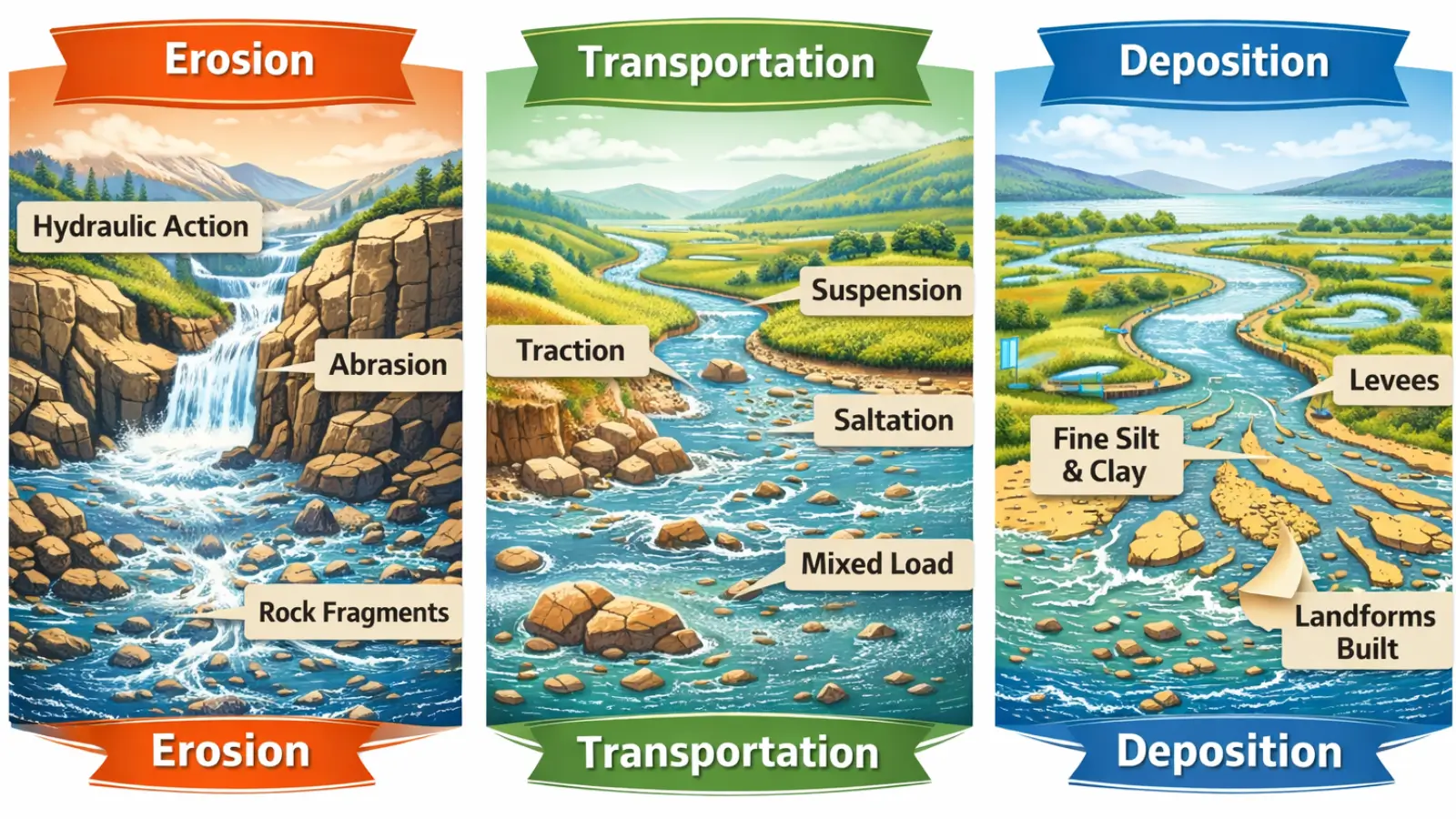
One of the most significant mechanisms is hydraulic action, in which the sheer force of moving water dislodges and removes loose material from the river bed and banks. This process is particularly effective during floods, when increased discharge and velocity intensify pressure fluctuations within rock joints and crevices.
Another important mechanism is abrasion, also known as corrasion. In this process, rock fragments carried by the river act as cutting tools, grinding against the bed and banks. Abrasion is responsible for deepening river channels and smoothing valley sides, especially in the upper and middle courses.
Attrition occurs when transported rock fragments collide with one another, breaking into smaller, more rounded pieces. Although attrition does not directly erode the channel, it produces finer sediments that are more easily transported downstream.
A less visible but significant process is solution, in which soluble minerals are dissolved by river water. This form of erosion is particularly effective in regions underlain by limestone or other soluble rocks and contributes to the dissolved load of rivers.
Types of Fluvial Erosion
Fluvial erosion operates in different directions. Vertical erosion dominates in the upper course, deepening the river bed and producing steep-sided valleys. Lateral erosion becomes more important in the middle and lower courses, widening the valley and contributing to meander formation. Headward erosion occurs at the source region, enabling the river to extend its length upstream and, in some cases, capture neighbouring streams.
Fluvial Transportation
Transportation refers to the movement of eroded material from one part of the river system to another. A river’s capacity to transport sediment depends on its velocity, volume, and turbulence, as well as the size and nature of the material.
Modes of Transportation
The finest materials, including minerals dissolved in water, are carried as solution. This dissolved load is invisible but constitutes a significant proportion of a river’s total load, especially in humid regions.
Suspension involves the transport of fine particles such as silt and clay, which are held within the water column by turbulence. Suspended load gives rivers a muddy appearance during floods and plays a major role in floodplain formation.
Coarser materials such as sand and small pebbles are transported by saltation, in which particles move in a series of short hops along the river bed. Larger and heavier fragments are moved through traction, where they are rolled or dragged along the bed by the force of flowing water.
Significance of Transportation
Transportation links erosion and deposition, making it central to fluvial processes. The nature of transported material influences channel morphology, flood behaviour, and sediment deposition downstream. Seasonal variations in discharge often result in marked changes in sediment transport, particularly in monsoon-fed rivers.
Fluvial Deposition
Deposition occurs when a river loses the energy required to carry its sediment load. This reduction in energy may result from a decrease in velocity, gradient, or discharge, or from an increase in channel width.
Conditions Favouring Deposition
Deposition is common in the lower course of a river, where the gradient is gentle and velocity declines. It also occurs during floods when rivers spill over their banks and spread across floodplains, and at river mouths where flowing water enters a standing body of water.
The size of sediment deposited depends on the extent of energy loss. Coarse materials are deposited first, followed by finer sediments, leading to well-defined patterns of sediment sorting.
Depositional Landforms
Depositional processes give rise to a variety of fluvial landforms. Floodplains are formed by repeated overbank deposition of fine sediments and represent some of the most fertile landscapes. Natural levees develop alongside river channels as coarser materials are deposited near the banks during floods.
Within the channel, deposition may form sand bars and river islands, which can alter flow patterns and trigger channel migration. At the river mouth, extensive deposition may result in the formation of deltas, characterised by distributary networks and rapid land-building processes.
Interrelationship of Fluvial Processes
Erosion, transportation, and deposition do not occur in isolation. They operate simultaneously within a river system, with their relative dominance shifting along the river course and over time. For example, a river may erode its banks on the outer side of a meander while depositing sediments on the inner side at the same time.
This dynamic balance reflects a river’s attempt to achieve graded equilibrium, in which its profile and channel form are adjusted to prevailing environmental conditions. Disturbances such as tectonic uplift, climatic change, or human intervention can disrupt this equilibrium, leading to renewed erosion or deposition.
Comparative Analysis of the Three Processes of Rivers
| Basis of Comparison | Erosion | Transportation | Deposition |
|---|---|---|---|
| Definition | Wearing away of river bed and banks by flowing water | Movement of eroded material downstream by the river | Settling of transported material when river energy declines |
| Role in River Action | Initiates landform development | Connects erosion and deposition spatially | Completes the cycle of river work |
| Dominant River Stage | Upper course (youthful stage) | Middle course (mature stage) | Lower course (old stage) |
| Energy Requirement | Very high kinetic energy | Moderate to high energy | Low energy conditions |
| Types / Mechanisms |
Hydraulic action, Abrasion, Attrition, Solution |
Traction, Saltation, Suspension, Solution |
Vertical deposition, Lateral deposition, Overbank deposition |
| Nature of Sediments | Large, angular rock fragments | Mixed load (boulders to silt) | Fine silt, clay, alluvium |
| Typical Landforms Produced | V-shaped valleys, gorges, waterfalls, potholes | Meanders, river cliffs, slip-off slopes | Floodplains, levees, deltas, oxbow lakes |
| Spatial Impact | Deepens and lengthens river valleys | Redistributes material along the course | Builds new landforms and plains |
| UPSC Relevance | Source of erosional geomorphology questions | Conceptual link between river stages | Frequently asked in delta and floodplain contexts |
Must Read Articles Associated with this Topic
This article is part of a series of articles that clear basic concepts of the drainage system and the river system. Students and aspirants are also advised to refer to the articles mentioned below.
- Drainage System & River System
- River Source & River Mouth
- Three Stages of River
- Three Processes of Rivers — Erosion, Transportation, and Deposition
- River Basin, Catchment Area, and Watershed
- River Tributaries & River Distributaries
- Drainage Patterns & Structural Control
- River Rejuvenation and Associated Fluvial Landforms
NCERT Geography Books and Other Sources
Students and aspirants are also advised to refer to the sources mentioned below.
- NCERT Geography Book of Class 9, Chapter 3: Drainage
- NCERT Geography Book of Class 11, Chapter 3: Drainage System
- BBC Geography: Three stages of river
- Article on Major River System in India created by India- Water Resource Information System (WRIS) by Ministry of Jal Shakti