
Among the lesser-known yet technologically significant innovations of India’s agrarian past is the Araghatta—a mechanical water-lifting device extensively used for irrigation during medieval times. Also spelled as aragatta or arghatta, the device represents an early attempt to mechanize water management in agriculture, long before the advent of modern pumps.Frequently mentioned in historical texts, inscriptions, and modern competitive examinations, the Araghatta occupies a crucial place in the study of medieval Indian economic and technological history.
Etymology and Meaning of Araghatta
The term Araghatta is derived from Sanskrit, where ara means “spoke” and ghatta means “pot” or “vessel.” The name precisely describes the structure of the device—a spoked wheel fitted with pots used to lift water from wells or tanks.
In ancient and medieval literature, variations such as arahatta, araghattika, and ghati yantra are also encountered. Over time, the device came to be popularly associated with what is now commonly called the Persian wheel.
Historical Background and Origin
References to water-lifting mechanisms resembling the Araghatta appear in early Indian literary sources, including the Panchatantra. However, its large-scale and systematic use became prominent during the early medieval period, particularly between the 7th and 13th centuries CE.
Epigraphic records from regions such as Rajasthan, Gujarat, and parts of the Deccan indicate the widespread adoption of Araghatta-based irrigation systems. Sculptural evidence from western India also
visually depicts the device in operation.
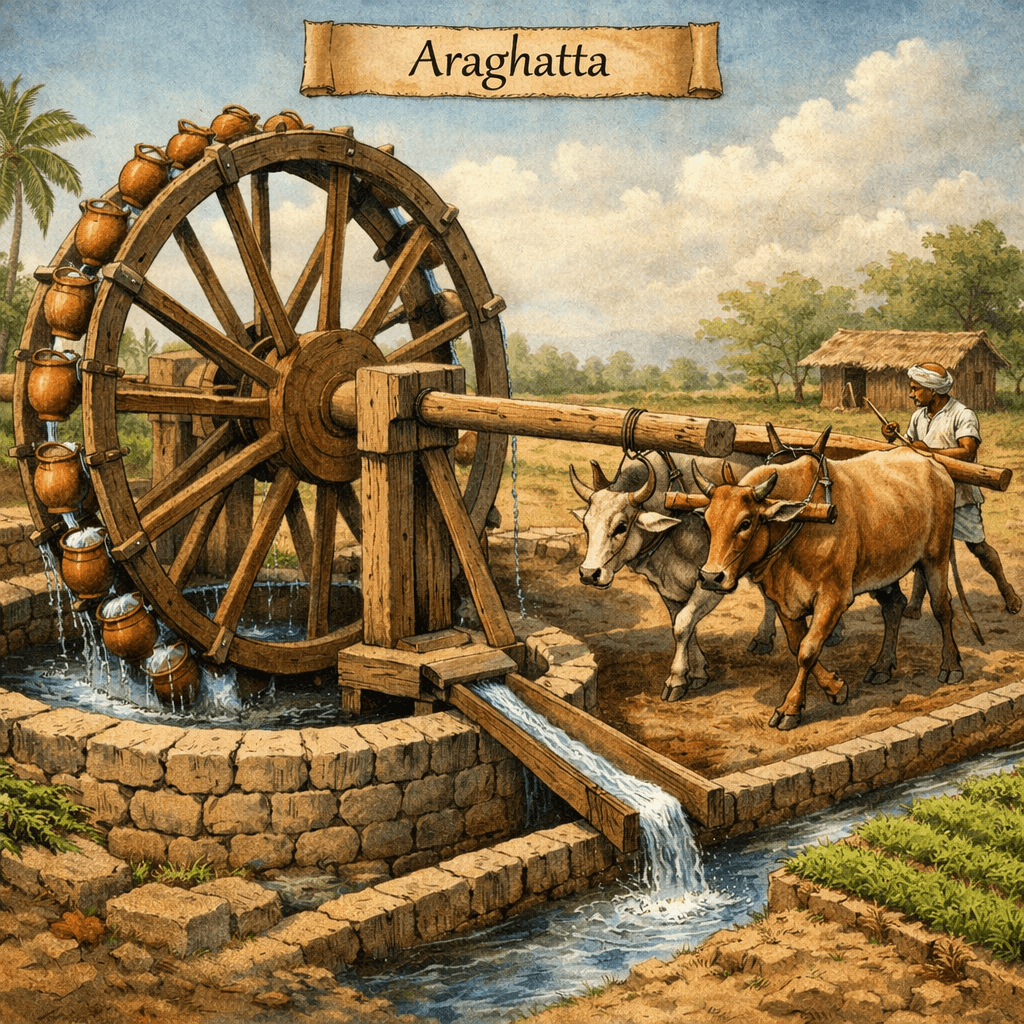
Structure and Components of Araghatta
The Araghatta consisted of a simple yet efficient mechanical arrangement designed to lift water
continuously with minimal effort.
- A large vertical wheel mounted on a wooden or stone frame
- Earthen pots or buckets attached to the spokes or a rope-chain
- A water source such as a well, tank, or stepwell
- A channel or trough to direct lifted water to agricultural fields
Working Principle and Scientific Basis
The device operated on the principle of rotational motion. As the wheel rotated, the pots dipped into the water source, filled up, and were carried upward. At the top of the rotation, the pots emptied their contents into a channel leading to irrigation fields.
Early Araghatta systems were manually operated. Over time, animal power—usually bullocks—was employed to rotate the wheel, significantly increasing water output and reducing human labor.
Comparison with Persian Wheel Saqiyah and Noria
Araghatta vs Persian Wheel (Saqiyah): While often equated with the Persian wheel in exam explanations, the early Indian Araghatta had distinct developmental features. The later Persian wheel — known as saqiyah — became widespread across West Asia and eventually in India, typically employing gears and animal power more systematically. The Persian wheel typically used advanced gear mechanisms, while the Araghatta remained simpler in construction.
Araghatta vs Noria: The noria is a water-lifting device powered by flowing water — often a river or stream — unlike the Araghatta, which relied on external power sources (human or animal).
Agricultural and Economic Importance
The widespread use of Araghatta contributed significantly to agricultural expansion in regions with limited rainfall. It enabled irrigation from deeper wells, thereby supporting multi-crop agriculture and enhancing food security.
Irrigated land using mechanical devices often yielded higher productivity and was sometimes taxed differently, highlighting the economic value of irrigation technology in medieval India.
Cultural Legacy and Modern Relevance
Although largely replaced by electric and diesel pumps, the legacy of Araghatta survives in rural vocabulary and traditional knowledge systems. The Hindi term rahat still reflects its historical presence.
The Araghatta stands as a remarkable example of medieval India’s practical engineering and adaptive
agricultural practices. It illustrates how traditional societies applied mechanical principles to overcome environmental constraints and sustain agrarian economies.
Understanding Araghatta is essential not only for examination purposes but also for appreciating the long technological continuum of Indian irrigation systems.
Also read: Major crafts and technology that existed during the Delhi Sultanate and the Mughals
FAQs Associated with Araghatta
Question: What is an Araghatta?
Answer: An Araghatta (also spelt aragatta or arghatta) is a mechanical water-lifting device used historically in India for irrigation. It comprises a large wheel fitted with pots (or buckets) that scoop water from a well or river and discharge it into channels for agricultural use.
Question: How did the Araghatta work?
Answer: The Araghatta operated on rotational motion, where pots attached to the wheel or a rope-chain dipped into water, filled up as the wheel turned, and then spilled water into a collection channel at the top. It was typically powered by human or animal force (e.g., bullocks or camels).
Question: Why is Araghatta significant in medieval Indian history?
Answer: In medieval India, Araghatta represented a technological innovation that expanded irrigation capabilities. By facilitating the lifting of water from wells and water bodies, it supported increased agricultural output, especially in semi-arid zones where rainfall was unreliable.
Question: Is Araghatta the same as a Persian wheel?
Answer: While often equated with the “Persian wheel,” Araghatta refers to the local Indian term and adaptation of a mechanical water-lifting system. The Persian wheel was a more standardized water wheel with gearing and animal drive mechanisms, whereas early Araghatta forms could be simpler in design.
Question: From what languages/words does the term Araghatta originate?
Answer: The term originates from Sanskrit: ara meaning “spoke” and ghatta meaning “pot,” describing the wheel with pots used to lift water. This etymology reflects the physical structure of the device.
Question: What were the main power sources for operating an Araghatta?
Answer: Araghatta devices were primarily operated by human effort or draught animals such as bullocks, buffaloes, and sometimes camels, which walked in circles to rotate the wheel, allowing continuous water lifting.
PYQs and MCQs associated with Araghatta
UPSC CSE 2025
Question 1. The irrigation device called ‘Araghatta’ was
(a) a water bag made of leather pulled over a pulley
(b) a large wheel with earthen pots tied to the outer ends of its spokes
(c) a larger earthen pot driven by bullocks
(d) a large water bucket pulled up by rope directly by hand
Correct Answer: (b) a large wheel with earthen pots tied to the outer ends of its spokes
UPSC CSE 2016
Question 2. With reference to the economic history of medieval India, the term ‘Araghatta’ refers to
(a) Bonded labour
(b) Land grants to military officers
(c) Waterwheel used in the irrigation of land
(d) Wasteland converted to cultivated land
Correct Answer: (c) Waterwheel used in the irrigation of land
Question 3. With reference to medieval Indian irrigation technology, which of the following statements about Araghatta is correct?
(a) It was used to grind grain using water power.
(b) It lifted water using a wind-driven mechanism.
(c) It consisted of a wheel with pots to lift water from a source.
(d) It was a type of rainwater harvesting system.
Correct Answer: (c) It consisted of a wheel with pots to lift water from a source.