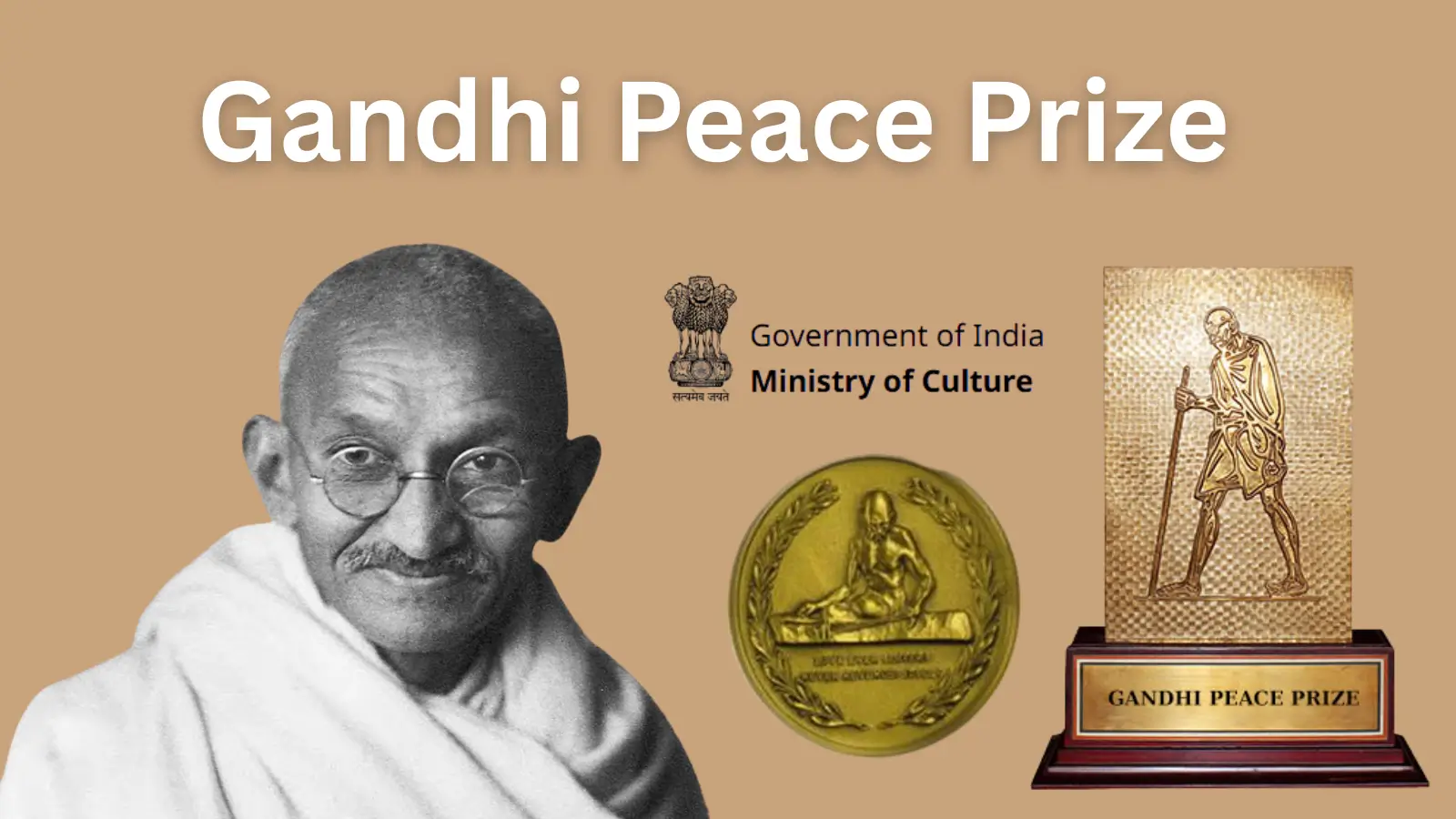
The International Gandhi Peace Prize is one of India’s most prestigious global awards, instituted to honour individuals and institutions that have made outstanding contributions to peace, non-violence, and humanitarian causes in the spirit of Mahatma Gandhi. The award reflects India’s commitment to Gandhian values in international affairs and global ethical leadership.
Origin and Background of International Gandhi Peace Prize
The prize was established by the Government of India in 1995, marking the 125th birth anniversary of Mahatma Gandhi. Its creation was intended to internationalise Gandhi’s philosophy of non-violence (Ahimsa), truth (Satya), and peaceful social transformation, making them relevant to contemporary global challenges such as conflict, inequality, environmental degradation, and human rights violations.
Unlike many peace awards that focus narrowly on conflict resolution, the International Gandhi Peace Prize recognises a broad spectrum of humanitarian action, including social justice, sustainable development, environmental protection, and community-based empowerment.
Eligibility and Scope
The award is open to all persons and institutions, regardless of nationality, race, religion, language, or gender. Both individuals and organisations—national or international—can be selected, underscoring the inclusive and universal nature of Gandhian ideals.
The prize often recognises lifetime contributions rather than isolated achievements, giving importance to sustained commitment and ethical consistency.
The International Gandhi Peace Prize may remain unawarded or delayed in certain years due to the discretionary, consensus-based selection process and the absence of a suitable candidate.
Award Components
The International Gandhi Peace Prize consists of:
- A cash award of ₹1 crore
- A citation
- An exquisitely crafted plaque
The monetary component symbolises practical support for peace-oriented work, while the citation and plaque serve as moral recognition at the global level.
Selection Process
The selection is made by a jury chaired by the Prime Minister of India, with other members nominated from among distinguished persons. This high-level composition reflects the symbolic and diplomatic importance of the award.
The final decision is announced annually, usually around Gandhi Jayanti (2 October), reinforcing the philosophical linkage between Gandhi’s legacy and contemporary peace efforts.
Composition of Jury Members
The jury consist of 5 members.
- Prime Minister of India (Chairperson) — Ex officio member and head of the jury.
- Chief Justice of India — Ex officio member.
- Leader of the Opposition (LoP) in the Lok Sabha. If there is no formal LoP, the leader of the single largest opposition party in the Lok Sabha. — Ex officio member.
- Eminent Public Figure (Nominated Member) — Typically an eminent individual nominated for a fixed term.
- Another Eminent Public Figure (Nominated Member) — Another nominated expert or distinguished person.
Key Administrative Authority
The International Gandhi Peace Prize is instituted, administered, and managed by the Government of India, specifically through the Ministry of Culture.
List of Recipients
Over the years, the prize has been awarded to globally respected figures and institutions, including:
- Nelson Mandela (South Africa) for his role in peaceful transition and reconciliation
- Grameen Bank and Muhammad Yunus for pioneering microfinance and social empowerment
- Khan Abdul Ghaffar Khan (posthumously) for non-violent resistance
- UNHCR for humanitarian assistance to refugees
- Gita Press for contributions to ethical and cultural values
The diversity of recipients highlights that peace is not limited to diplomacy alone but extends to economic justice, education, cultural preservation, and humanitarian service.
The complete list of recipients is given below.
| Year | Recipient | Country / Affiliation |
|---|---|---|
| 1995 | Julius Kambarage Nyerere | Tanzania (Former President) |
| 1996 | A. T. Ariyaratne | Sri Lanka (Sarvodaya Shramadana Movement) |
| 1997 | Gerhard Fischer | Germany (Diplomat & Humanitarian) |
| 1998 | Ramakrishna Mission | India (Spiritual & Social Organisation) |
| 1999 | Baba Amte | India (Social Reformer) |
| 2000 | Nelson Mandela | South Africa (Former President) |
| 2000 | Grameen Bank | Bangladesh (Microfinance Institution) |
| 2001 | John Hume | Northern Ireland (Peace Process Leader) |
| 2002 | Bharatiya Vidya Bhavan | India (Educational & Cultural Trust) |
| 2003 | Václav Havel | Czech Republic (Former President) |
| 2004 | Coretta Scott King | USA (Civil Rights Activist) |
| 2005 | Desmond Tutu | South Africa (Cleric & Human Rights Activist) |
| 2006–2012 | Award Not Conferred | |
| 2013 | Chandi Prasad Bhatt | India (Environmental Activist) |
| 2014 | Indian Space Research Organisation (ISRO) | India (Space Agency) |
| 2015 | Vivekananda Kendra | India (Spiritual & Service Organisation) |
| 2016 | Akshaya Patra Foundation | India (Mid-Day Meal Programme) |
| 2016 | Sulabh International | India (Sanitation & Social Reform) |
| 2017 | Ekal Abhiyan Trust | India (Rural Development) |
| 2018 | Yōhei Sasakawa | Japan (Philanthropist) |
| 2019 | Qaboos bin Said Al Said | Oman (Former Sultan) |
| 2020 | Sheikh Mujibur Rahman | Bangladesh (Founding Leader, Posthumous) |
| 2020 | Sheikh Mujibur Rahman | Bangladesh (Founding Leader, Posthumous) |
| 2021 | Gita Press, Gorakhpur | India (for outstanding contribution towards social, economic and political transformation through non-violent and other Gandhian methods) |
Significance in International Relations
The International Gandhi Peace Prize serves as an instrument of soft power diplomacy for India. By honouring global peacebuilders, India reinforces its civilisational ethos rooted in non-violence and moral leadership.
The prize also complements India’s broader engagement with global governance, sustainable development goals, and humanitarian norms, positioning Gandhian philosophy as a viable framework for addressing modern global crises.
Relevance for UPSC Examinations
For UPSC Civil Services aspirants, the International Gandhi Peace Prize is important from multiple perspectives:
Prelims: Factual questions on origin, year, eligibility, and components
Mains (GS-IV): Ethics, Gandhian philosophy, peace and non-violence
Essay: Moral leadership, non-violence in international politics, humanitarian values
International Relations: India’s soft power and normative influence
The International Gandhi Peace Prize is more than an annual award; it is a reaffirmation of the enduring relevance of Gandhian values in a conflict-prone world. By recognising those who pursue peace through ethical means and humanitarian action, the prize bridges historical ideals with contemporary global realities, keeping alive Gandhi’s vision of a just and non-violent world order.
Frequently Asked Questions (FAQs) Associated with International Gandhi Peace Prize
1. What is the International Gandhi Peace Prize?
The International Gandhi Peace Prize is an annual award instituted by the Government of India to honour individuals or institutions for outstanding contributions to peace, non-violence, and social transformation inspired by Mahatma Gandhi.
2. When was the International Gandhi Peace Prize instituted?
The prize was instituted in 1995 to commemorate the 125th birth anniversary of Mahatma Gandhi.
3. Who administers the International Gandhi Peace Prize?
The prize is administered by the Ministry of Culture, Government of India, which manages nominations, selection coordination, and award disbursal.
4. Who selects the recipient of the International Gandhi Peace Prize?
The recipient is selected by a five-member jury chaired by the Prime Minister of India, with the Chief Justice of India, the Leader of the Opposition in the Lok Sabha (or leader of the largest opposition party), and two eminent persons as members.
5. Is the International Gandhi Peace Prize awarded every year?
No. The prize is discretionary and need not be awarded annually. If the jury finds no suitable candidate meeting Gandhian ideals, the award may be withheld or delayed.
6. What is the prize money for the International Gandhi Peace Prize?
The award carries a cash prize of ₹1 crore, along with a citation and a traditional handicraft or handloom item.
7. Who can receive the International Gandhi Peace Prize?
The prize is open to individuals or institutions, irrespective of nationality, race, gender, or ideology, provided their work aligns with Gandhian principles of peace and non-violence.
8. Can institutions receive the International Gandhi Peace Prize?
Yes. Several institutions such as Ramakrishna Mission, ISRO, and Grameen Bank have received the prize.
9. Can the prize be awarded posthumously?
Yes. The prize can be awarded posthumously, as seen in the case of Sheikh Mujibur Rahman (2020).
10. Where is the International Gandhi Peace Prize ceremony held?
The award ceremony is generally organised in New Delhi, usually around 2 October, marking Gandhi Jayanti.
11. Why was the International Gandhi Peace Prize not awarded in certain years?
In some years, the award was not conferred due to lack of consensus within the jury or the absence of a suitable nominee meeting the award’s criteria.
PYQs & MCQs Associated with International Gandhi Peace Prize
Question: Who amongst the following are members of the Jury to select the recipient of the ‘Gandhi Peace Prize’?
I. The President of India
II. The Prime Minister of India
III. The Chief Justice of India
IV. The Leader of Opposition in the Lok Sabha
Select the correct answer using the code given below.
(a) II and IV only
(b) I, II and III
(c) II, III and IV
(d) I and III only
Correct Answer: (c) II, III and IV
Question: With reference to the Gandhi Peace Prize, consider the following statements:
1. It is awarded annually.
2. It is open to individuals and institutions.
3. It can be awarded posthumously.
Which of the statements given above are correct?
(a) 1 and 2 only
(b) 2 and 3 only
(c) 1 and 3 only
(d) 1, 2 and 3
Correct Answer: (c) 2 and 3 only
UPPSC Prelims 2020
Question: Gandhi Peace Prize is awarded by which of the following?
(a) United Nations
(b) Government of India
(c) UNESCO
(d) Nobel Committee
Correct Answer: (b) Government of India
(a) Liberalism
(b) Socialism
(c) Non-violence
(d) Realism
Correct Answer: (c) Non-violence
MPPSC Prelims 2022
Question Which of the following institutions has received the Gandhi Peace Prize?
(a) ISRO
(b) DRDO
(c) BARC
(d) CSIR
Correct Answer: (a) ISRO
BPSC 65th Combined Competitive Exam
Question: Who is the winner of the International Gandhi Peace Prize for 2018?
(a) Yohei Sasakawa
(b) Akshaya Patra Foundation
(c) Sulabh International
(d) Ekal Abhiyan Trust
Correct Answer: (a) Yohei Sasakawa
RPSC State PSC 2023
Question: Which institution in India has been selected for Gandhi Peace Award (Prize) 2021?
(a) Gita Press, Gorakhpur
(b) Sulabh International
(c) Vivekananda Kendra, Kanyakumari
(d) Ramakrishna Mission
Correct Answer: (a) Gita Press, Gorakhpur
CDS (Combined Defence Services) 02/2021
Question: Who amongst the following was honoured with the Gandhi Peace Prize for the year 2020?
(a) Qaboos bin Said Al Said
(b) Sheikh Mujibur Rahman
(c) Ekal Abhiyan Trust
(d) Sulabh International
Correct Answer: (b) Sheikh Mujibur Rahman